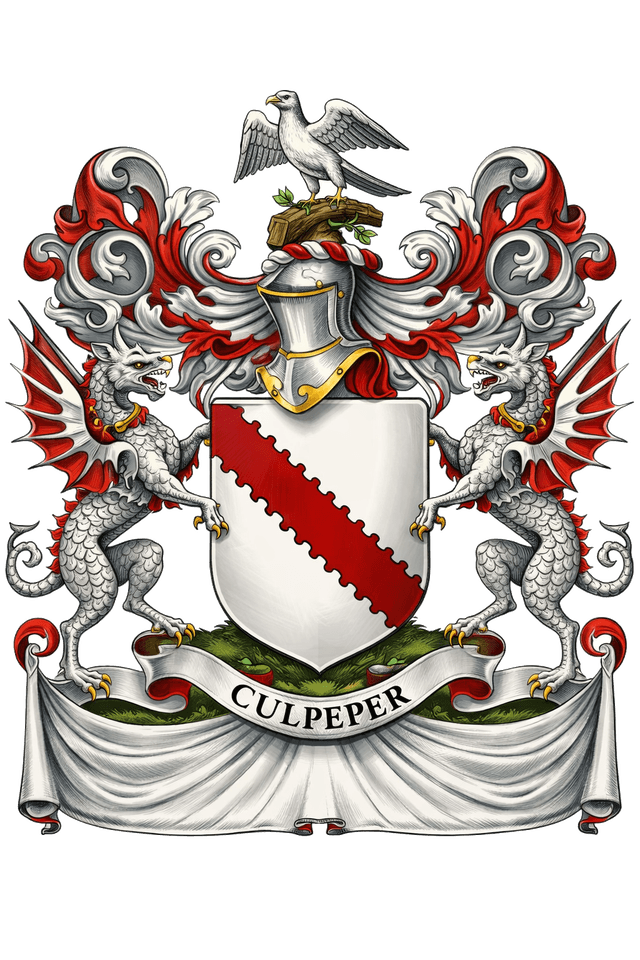
The Culpepper Family Crest
Heraldic Symbol of the English Culpeper Family
The Coat of Arms
The Culpepper family coat of arms is one of the most distinctive and recognizable heraldic designs from medieval England. The arms were granted to the Culpepper family of Kent and have been associated with the family since the medieval period.
Heraldic Description (Blazon)
From Burke's General Armory:
Argent, a bend engrailed, gules
In plain language: A silver (white) shield with a red diagonal stripe indented with small concave curves running from the upper left to the lower right.
Key Elements
- •Argent (Silver/White): Represents peace, sincerity, and purity
- •Gules (Red): Symbolizes military fortitude and magnanimity
- •Bend Engrailed: A diagonal stripe with wavy, scalloped edges
The Crest
Above the shield and helmet is the crest, described in Burke's as:
“A silver falcon with extended wings whose beak and bells are gold.”
A more elaborate description from an old Colepeper pedigree chart: “On a trunk of a tree, lying fessways, a branch issuant from the dexter end, proper, a falcon, wings expanded, argent, beaked, belled and legged, or.”
Family Mottos
In England, mottos do not form part of the patent and can vary within families and across generations. Three different mottos have been documented with the Culpeper Coat of Arms:
J'espère
“I hope”
This French motto was used by the Barbados Culpepers and by John, Lord Culpeper, Governor of Virginia. It reflects optimism and forward-looking confidence.
Jesu Christe fili Dei miserere mei
“Jesus Christ, Son of God, have mercy upon me”
Found on a pedigree chart for the Colepepers of Bedgebury, this religious motto was noted by Sir Alexander Colepeper. However, its length is unusual for a heraldic motto, so its authenticity as an official family motto is uncertain.
Fides fortitudio fastio
“Faith, Courage, Dignity” (or “Faith, Duty, Honor”)
This Latin-appearing motto has appeared with the Coat of Arms, though its origin is uncertain. The words “fortitudio” and “fastio” are not standard classical Latin, suggesting this may be a later creation rather than an authentic historical motto. Dr. Sarah Culpepper Stroup, a Classics professor, analyzed these terms and suggested they may be neologisms formed to create a motto with alliterative appeal.
Some interpret this motto as embodying warrior virtues of faith, fortitude (duty to act rightly), and honor (dignity earned through sacrifice).
Historical Context
The English Culpepers
The Culpepper family of England rose to prominence in Kent during the medieval period. They held extensive lands and titles, including:
- •Barons Culpeper of Thoresway (created 1644)
- •Lords of multiple manors in Kent and Sussex
- •Colonial administrators in Virginia
- •Notable members included Thomas, Lord Culpeper, Governor of Virginia
Virginia Connection
While the coat of arms and motto were associated with the noble English Culpepers, the relationship to American Culpeppers remains a subject of research:
- •Henry Culpeper of Virginia (our progenitor) used various spellings of the name
- •No documented right to bear the noble family's arms
- •DNA evidence suggests a separate line from noble Culpepers
- •The crest remains a symbol of family heritage and identity
Understanding Heraldry
The system of heraldry developed in medieval Europe as a way to identify knights in battle and establish noble lineage. Each element of a coat of arms carried specific meaning:
Colors (Tinctures)
Each color in heraldry has symbolic meaning. Red (gules) represents courage and military strength, while silver (argent) symbolizes peace and sincerity.
Patterns (Ordinaries)
The bend is one of the “honorable ordinaries” in heraldry. The engrailed edge (wavy pattern) adds distinction and may reference water or land.
Inheritance
Coats of arms were passed down through male lines and modified with additional elements to distinguish different family branches.
Modern Usage
Today, the Culpepper family crest serves as a symbol of family heritage and connection to our shared history. While most American Culpeppers do not have a legal right to bear the historic coat of arms, it remains an important symbol of family identity and pride.
A Note on Usage
In traditional heraldry, coats of arms belong to individuals and their direct male descendants, not to all people sharing a surname. As noted by Culpepper Connections: “Where Coats of Arms have existed, they have always been associated with a specific family and the right to display the Coat passed from generation to generation through the male line.”
While no modern day Culpepper can claim the legal “right” to display this Coat of Arms, many have adopted it as a symbol of family heritage. The Culpepper arms displayed on this website represent our family's historical connection to the name, even though the exact relationship between American and English Culpepers continues to be researched through DNA analysis and genealogical records.
Historical References:
- • Burke, John and John Bernard Burke: General Armory of England, Scotland, Ireland and Wales. London: Harrison and Sons, 1884.
- • Michael Drayton's The Barons Warres, Canto 2, Verse 23: “And Culpeper, in Silver Arms enrayl'd Bare thereupon a bloudie Bend engrayl'd”
- • Information compiled from Culpepper Connections